
Criminal Cases in the Scurry County Courts
The 132nd District Court is Scurry County's felony court. Its judge works in Suite 404 of the Scurry County Courthouse, while District Clerk Lana Warr keeps the filed criminal cases in Suite 402. The constitutional County Court handles Class A and Class B misdemeanors, and County Clerk Melody Appleton keeps those files in Suite 300. The state district-court directory identifies no county court at law for Scurry County.
Fine-only matters do not move through those same Scurry County criminal case files. Snyder Municipal Court keeps city ordinance and fine-only state-law cases. Justice of the Peace Precincts 1 and 2 hold fine-only matters within their county jurisdiction and may conduct magistration. A reader who starts with the wrong clerk may get no result even though a valid case exists elsewhere.
The official 132nd District Court page shows the local felony venue.
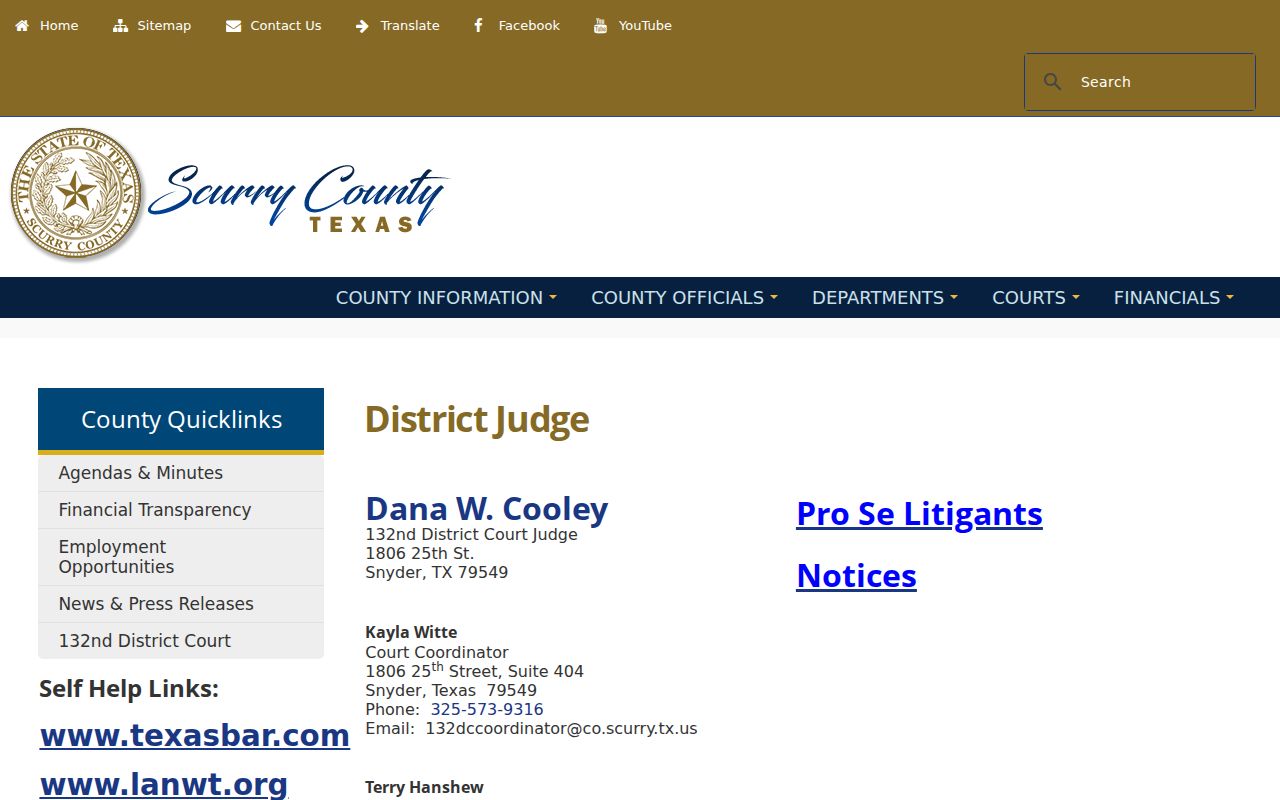
The court page helps confirm the office before a docket or document request is sent.
Scurry County places its main court record custodians in one courthouse, but their authority remains distinct. District Clerk staff preserve felony pleadings, orders, and judgments. County Clerk staff preserve the county misdemeanor file. A visit should begin with the cause number and exact document name when possible. If only a name is known, provide a filing range and ask whether staff can search the Scurry County index. The research found no published criminal-copy, certification, search, or archive fee schedule, so ask for current charges and any retrieval time before placing an order.
Scurry County Court Levels
Follow the offense class, not the arresting agency. Texas Penal Code Chapter 12 supplies the baseline classifications. A Snyder police arrest can become a Scurry County District Court felony, a County Court misdemeanor, or a Snyder Municipal Court fine-only case. The prosecutor's filed charge controls the court path. An arrest label may change after review or grand-jury action.
| Court or office | Criminal role | Contact |
|---|---|---|
| 132nd District Court / District Clerk | Felonies and district criminal cases | 1806 25th St., Suites 404/402; 325-573-5371 / 325-573-9316 |
| Scurry County Court / County Clerk | Class A and B misdemeanors | 1806 25th St., Suite 300; 325-573-9316 |
| Justice Courts 1 and 2 | Fine-only cases and magistration | 1300 26th St., Suites 205/202; 325-573-5406 |
| Snyder Municipal Court | City ordinance and fine-only state-law cases | 1925 24th St.; 325-573-4958 |
Note: A Scurry County arrest does not reveal the final court level because prosecutors may alter the charge before filing.
How to Search Case Records
Scurry County does not offer one conventional name-query database for every local criminal file. The District Clerk instead publishes dated docket PDFs, while clerks provide the fuller file through their counters and contact channels. Use this sequence to avoid treating a setting list as final proof.
- Choose the likely court from the charge level. Start with the District Clerk for a felony, County Clerk for a Class A or B misdemeanor, and municipal or justice court for a fine-only matter.
- Open the District Clerk docket page for posted arraignment, pretrial, motion-to-revoke, or motion-to-adjudicate lists.
- Match the cause number, abbreviated offense, counsel, bond notation, and setting date. Do not collect or republish names from a public setting sheet.
- Contact the correct clerk with the cause number and request exact documents, such as the indictment or information, docket sheet, judgment, and sentence.
- Use re:SearchTX as a supplemental trial-court channel. Coverage, documents, fees, and access vary, so confirm the result with the Scurry County clerk.
The local publication is a document list rather than a search form. Its visible fields are still useful when read in context.
| Field label | Type | Required | Notes |
|---|---|---|---|
| Setting type | PDF header/list | Yes | Arraignment, pretrial, MTR, MTA, or another setting |
| Court date and time | PDF header | Yes | Shows the calendar, not the outcome |
| Docket or cause number | Row text | Yes | Best identifier for a clerk request |
| Offense | Abbreviated row text | Yes | May need clarification from the filed charge |
| Attorney and bond | Row text | Varies | May list counsel and bond provider or notation |
Scurry County Docket PDFs
Scurry County's posted setting sheets are a useful low-tech portal. They show when felony cases are set for arraignment, pretrial, motions to revoke, motions to adjudicate, and other hearings. A setting sheet can establish that a cause exists and indicate its present stage. It does not supply the full indictment, event history, judgment, sentence, or fine ledger.
This distinction prevents a common error. A row on an arraignment list is not a disposition. Likewise, an MTR or MTA setting shows a supervision dispute is before the court, not that the judge granted the motion. Request the signed order or judgment when the outcome matters.
The Texas appellate Case Search provides the separate statewide interface for appealed cases.
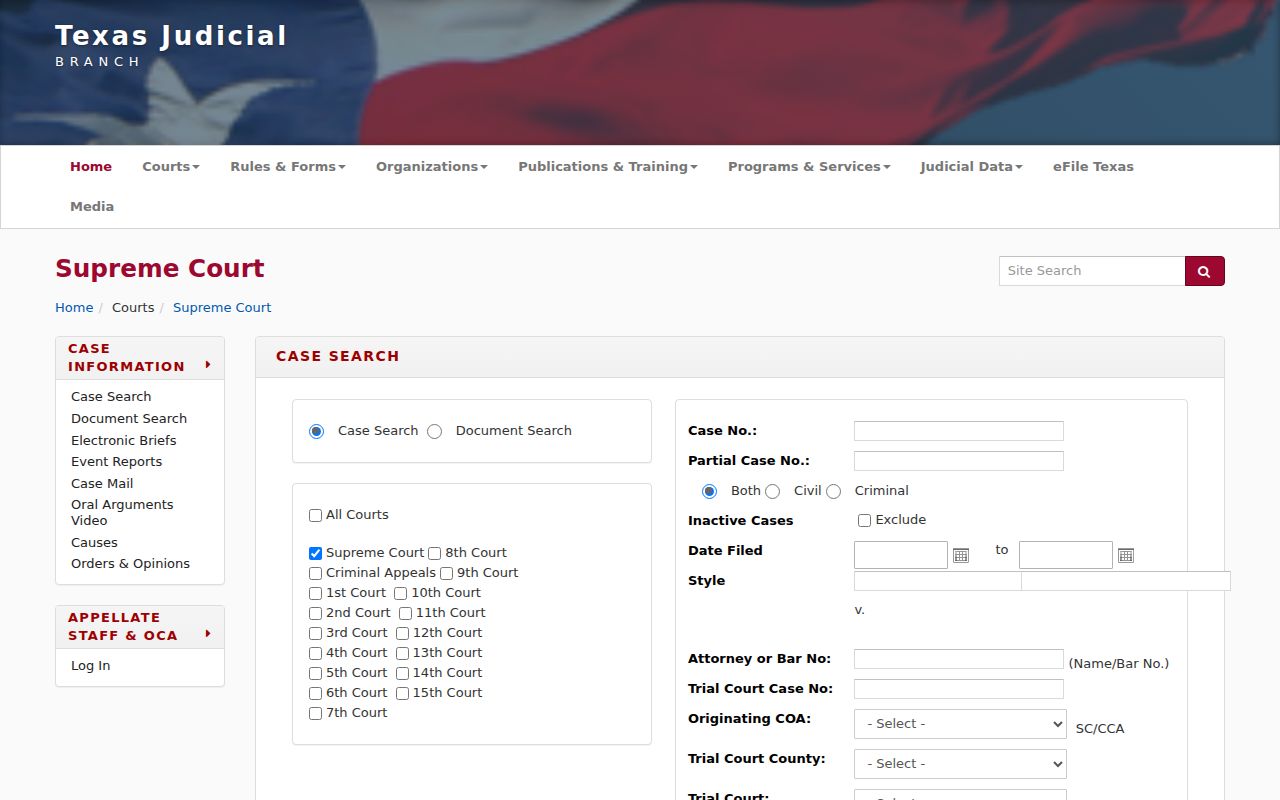
The separate appellate interface is useful only after a trial-court matter reaches an appellate court.
What the Case File Shows
A complete Scurry County criminal case file records what prosecutors filed and what the court did. Ask for named documents instead of requesting a vague background check. The judgment and sentence answer different questions from a calendar or arrest report.
| Case Number & Court | Identifies the cause and the Scurry County court with authority over it. |
|---|---|
| Charging Document | An indictment, information, or complaint states the filed accusation. |
| Docket Entries | Log filings, hearings, motions, pleas, and orders in sequence. |
| Hearing Dates | Show settings and appearances, but a setting alone does not prove an outcome. |
| Disposition & Judgment | Records dismissal, acquittal, deferred adjudication, or conviction and the signed ruling. |
| Sentence & Conditions | States confinement, fine, restitution, or community-supervision terms when ordered. |
The file may also contain bond, capias, appellate notice, and cost entries. Protected identifiers, juvenile information, sealed material, and some victim details can be withheld or redacted.
Scurry County Docket Terms
Local docket abbreviations describe a stage, not always a result. Four terms are especially useful when reading Scurry County criminal court case calendars.
- Arraignment
- The charge is formally presented and a plea is taken.
- Disposition
- The recorded outcome, such as conviction, dismissal, acquittal, or deferred adjudication.
- Motion to revoke
- A request alleging a violation after community supervision followed a conviction.
- Motion to adjudicate
- A request to enter guilt after an alleged violation during deferred adjudication.
A dismissal ends the filed charge without a conviction, but it does not itself delete the arrest cycle. Texas expunction or nondisclosure rules must be assessed separately.
Stages of a Criminal Case
A Scurry County criminal case begins after the prosecutor chooses to file a complaint, information, or indictment. Felony review may include grand-jury action. The court then moves the case through hearings, motions, and a plea or trial. If supervision is later challenged, a motion to revoke or adjudicate can create a new setting in the same cause.
Case flow: Charges Filed › Arraignment › Pretrial › Plea or Trial › Disposition › Sentencing
After judgment, an appeal moves to a Texas appellate court. The official appellate Case Search is separate from the local Scurry County criminal case record and is refreshed on its own schedule.
The Texas judiciary forms and rules gateway is the official source shown below.

The judiciary's forms gateway helps identify official forms, but the clerk should confirm what a specific Scurry filing requires.
Scurry Cases and re:SearchTX
re:SearchTX is Texas's statewide trial-court document and data platform. It can help locate trial-court material, yet user roles, registration, court participation, document access, and charges vary. A blank result is not proof that Scurry County has no criminal case. The local clerk remains the source for completeness and certification.
Use the platform to find a lead, then give the District Clerk or County Clerk the cause number and exact document title. Ask whether the record is digitized, onsite, or archived. Current local plain-copy, certification, search, and archive charges were not found in the official sources, so request a written estimate before ordering.
The PACER system is a separate path for federal court cases.
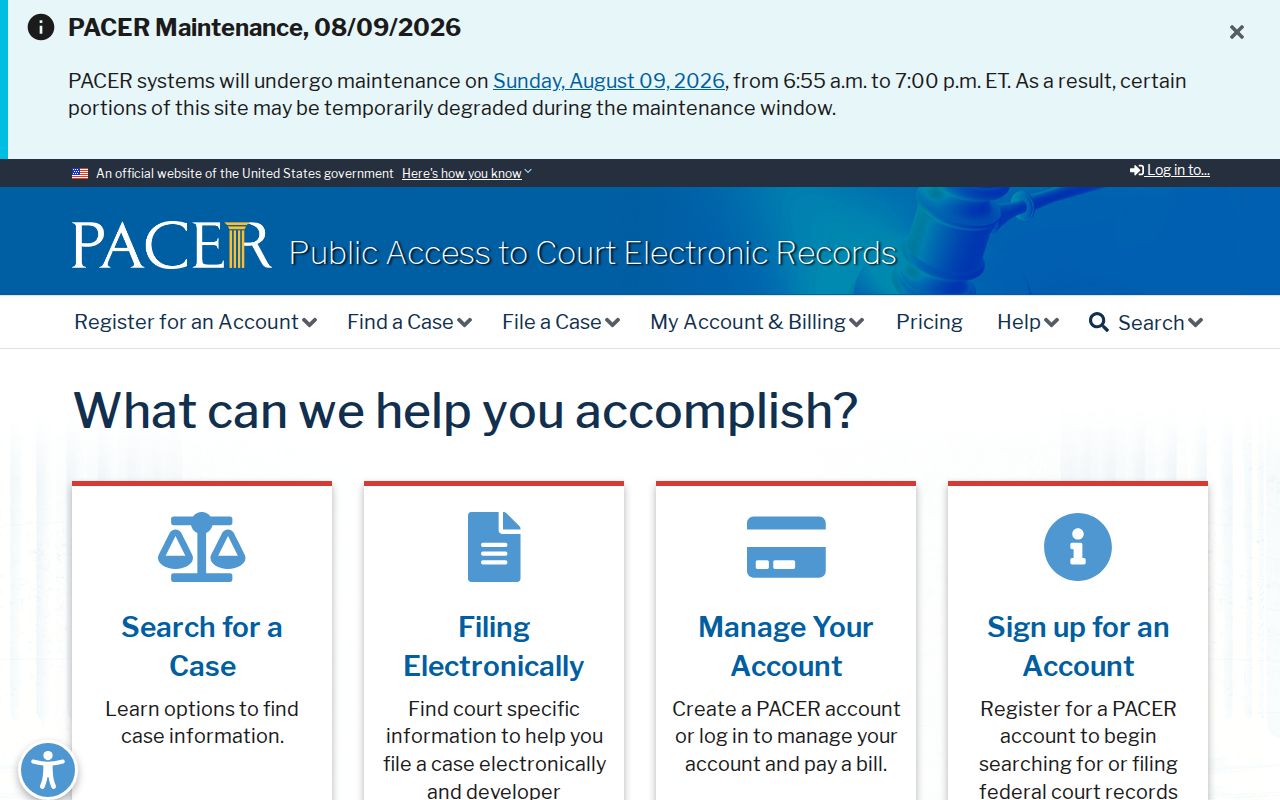
PACER does not search Scurry County clerk files because federal dockets are held by federal courts.
Access & Restrictions
The Texas Public Information Act governs executive-agency records, but judicial records follow the court and clerk access framework. Send a filed felony document request to the District Clerk and a county misdemeanor request to the County Clerk. Police reports and jail booking records stay with their creators rather than becoming the court's full case file.
Public access has limits. Juvenile files, sealed or expunged matters, protected victim details, personal identifiers, grand-jury deliberative material, and some active investigative content may not be released. Online views can also be narrower than the file held at the counter. If no search result appears, ask the clerk to check the name, cause number, filing range, archives, and any access restriction.
Federal Cases From Scurry County
Federal charges arising in Scurry County belong to the U.S. District Court for the Northern District of Texas. The U.S. Attorney's Office prosecutes federal cases, and the U.S. Marshals Service handles federal fugitive and prisoner functions. These records do not automatically appear in the District Clerk's local file. PACER requires registration and applies the current federal electronic-access fee schedule.
The federal and local systems should not be blended. A state charge can have a Scurry County case while a separate federal matter has its own docket. Search each sovereign's official court. Use the case number, filing court, and charging document to confirm which record is being read.
The Northern District court site shows the proper federal venue for cases tied to Scurry County.
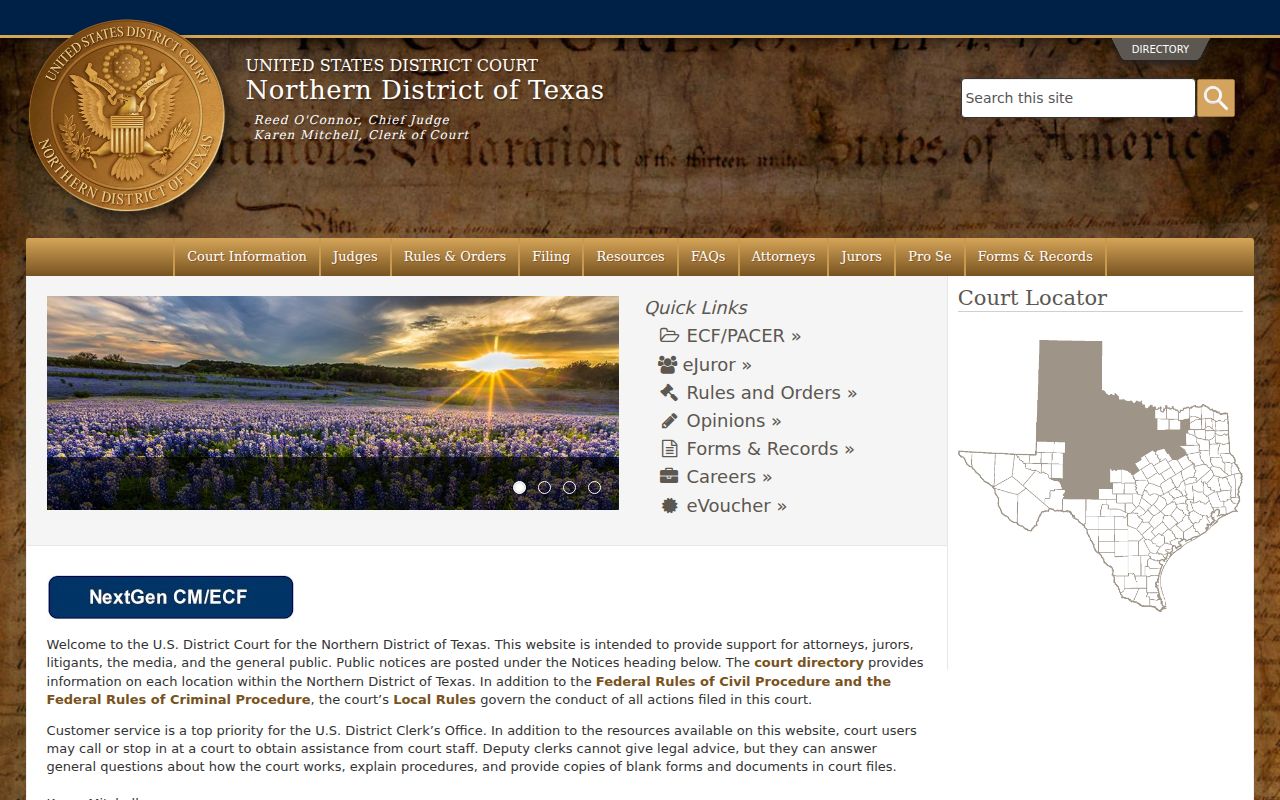
Federal custody and court records remain separate from Scurry County's jail and clerk systems.